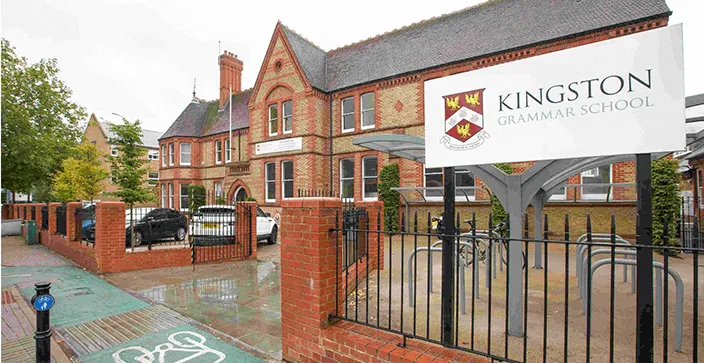
Kingston Grammar School (KGS) assesses prospective Year 7 pupils through its own bespoke 11+ entrance examination, designed to identify academic potential and suitability for the school's rigorous curriculum.
The assessment process typically involves a written examination in English and Mathematics, followed by an interview for shortlisted candidates. This approach ensures a comprehensive evaluation of each child's abilities for Kingston Grammar School entry.
English Examination
The 50-minute English paper for Kingston Grammar School is designed to evaluate a child's reading comprehension, writing skills, and command of language. It typically comprises two main sections:
- Reading Comprehension: Candidates are presented with a passage and must answer questions demonstrating their understanding, ability to infer meaning, analyse text, and interpret vocabulary. Responses often require using their own words.
- Creative Writing: This section assesses a child's ability to construct a coherent and imaginative piece of writing, often inspired by the provided comprehension passage. Emphasis is placed on originality, structure, vocabulary, spelling, punctuation, and grammar.
A strong performance in English requires not only accurate grammar and spelling but also the ability to engage critically with text and express ideas clearly and creatively.
Subject | Topic | Estimated Share |
|---|
English | Reading Comprehension (including vocabulary, inference, analysis) | Approximately 50-60% |
English | Creative Writing (narrative/descriptive, grammar, spelling, punctuation) | Approximately 40-50% |
Mathematics Examination
The 50-minute Mathematics paper at Kingston Grammar School covers a broad range of topics aligned with the Key Stage 2 National Curriculum, extending to some Level 5 concepts.
The paper assesses problem-solving skills, numerical fluency, and mathematical reasoning. Candidates are expected to show all necessary workings.
Key areas typically include:
- Number: Place value, addition, subtraction, multiplication, division (including long multiplication and division), fractions, decimals, and percentages.
- Measurement: Calculations involving money, time, length, area, volume, mass, and speed, primarily using metric units.
- Geometry: Properties of 2D and 3D shapes, angles, perimeter, and understanding of position and direction.
- Statistics: Interpretation of data presented in various forms, such as tables and line graphs.
A thorough understanding of core mathematical principles and the ability to apply them to multi-step problems are crucial for success in the Kingston Grammar School 11+ Maths exam.
Subject | Topic | Estimated Share |
|---|
Mathematics | Number (including fractions, decimals, percentages) | Significant focus (approx. 40-50%) |
Mathematics | Measurement (money, time, length, area, volume, mass, speed) | Important component (approx. 20-25%) |
Mathematics | Geometry (shapes, angles, perimeter, position) | Key area (approx. 15-20%) |
Mathematics | Statistics (data interpretation) | Smaller but present (approx. 5-10%) |
The Interview
Candidates who perform strongly in the written examinations will be invited for an interview. This is a vital part of the Kingston Grammar School admissions process, allowing the school to assess a child's personality, interests, communication skills, and genuine enthusiasm for learning.
The interview may involve a general conversation or delve into specific subjects like English or Mathematics, based on the candidate's exam performance.
Best Resources for Kingston Grammar School 11+ Preparation
Preparing for the Kingston Grammar School 11+ exam requires focused practice with materials that mirror the school's independent paper style.
For comprehensive preparation, exploring a wide range of 11 plus exam papers can be highly beneficial. PiAcademy offers a selection of resources tailored to help children excel in these assessments.